Quarkus Network Faults
Verify what your application does when a dependency is down, unreachable, slow, hung, or dies mid-call, from an ordinary @QuarkusTest.
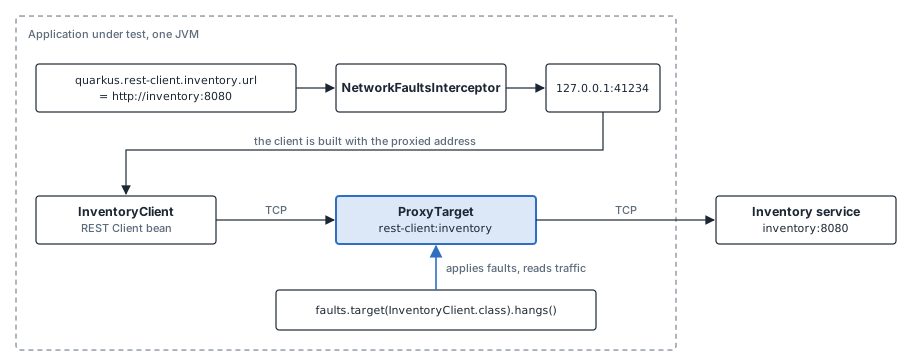
The Quarkus Network Faults extension places an in-process proxy in front of every outbound connection the configuration of your application describes, and lets your tests apply faults to it. No Docker and no external tooling are involved: the proxy is a Vert.x server inside the test JVM, and a test addresses a dependency by the bean the application injects to reach it.
@QuarkusTest
@TestProfile(NetworkFaultsProfile.class)
class OrderResourceTest {

    @Inject
    NetworkFaults faults;

    @Test
    void inventoryServiceHangs() {
        try (var ignored = faults.target(InventoryClient.class).hangs()) {
            // the @Timeout fallback
            when()
                    .post("/orders")
                    .then()
                    .statusCode(503);
        }

        // recovered, breaker reset
        when()
                .post("/orders")
                .then()
                .statusCode(201);
    }
}
Why Use Quarkus Network Faults?
Resilience is a property of each service’s own code: its timeouts, its retries, its fallbacks. Those are tested best where they live, in the service’s own test suite, against a dependency made to fail on purpose, rather than in an end-to-end environment where a failure is hard to produce and harder to attribute. This extension makes the dependency fail on purpose, inside the test JVM.
-
Nothing to start: the proxy runs inside the test JVM, so there is no container, no sidecar and no port to manage, and Dev Services work unchanged
-
Targets are the beans you already inject:
faults.target(InventoryClient.class)orfaults.target(DataSource.class), with the same qualifiers the application uses -
Faults the network really produces: refused connections, connect timeouts, hangs, latency, resets in the middle of a response, and HTTP error statuses
-
Consequences are undone: when a fault ends, and after every test, Agroal pools are flushed and SmallRye Fault Tolerance circuit breakers are reset
-
A guard against tests that test nothing: a test whose fault no connection went through fails, and the message names the configuration property to look at
-
Calls are counted: every HTTP request is counted and listed, even the ones a fault never relayed, so retries and open circuit breakers can be asserted
-
Dev UI: with
quarkus.network-faults.enabled=truein the dev profile, the Network faults card lists every target, applies and ends faults, drops connections and shows the event log of the running application
What Can You Test?
Any outbound connection the extension recognises in the configuration can be faulted: REST Clients, JDBC and reactive datasources, Redis, MongoDB, GraphQL and gRPC clients, and Quarkus LangChain4j models, stores and MCP servers.
Use it to check:
A REST dependency that is down, hangs or cannot be reached, and with it the @Fallback, the @Timeout and the connect and read timeouts of the client.
A remote API that answers with an error status, such as a 429 or a 503, for every request or only for the first few.
A database that dies mid-transaction or hangs, and with it the rollback, the socket timeout of the driver and the validation of pooled connections.
A streamed response that is cut or stalls half-way, right after its headers or after a number of Server-Sent Events.
A model provider that fails behind a Quarkus LangChain4j AI service, and what each failed prompt costs.
An MCP server or a chat memory store that fails in the middle of a conversation, and what the conversation does then.
Retries and circuit breakers, by counting the requests that were really sent.
Where to Go Next?
Add the extension and write a first fault test in a few minutes. |
|
Test what a request does when the remote API is down, hangs, cannot be reached or answers with an error status. |
|
Test rollback, socket timeouts and pool validation when the database dies or hangs. |
|
Exercise |
|
Every fault, every moment in a response it can strike at, and every target it can be applied to. |
Why not use Toxiproxy directly?
Toxiproxy is the de facto tool for injecting network faults. It runs as a separate process, usually a container, in which a test creates proxies and at which it then points the application.
That leaves the test in charge of everything around the fault: starting the proxy, routing each connection of the application through it, and cleaning up what a fault leaves behind in the application.
The Quarkus Network Faults extension builds the proxy into the test run and takes care of that for you:
-
Targets are discovered from the configuration of the application, Dev Services included
-
A test names a dependency by its bean, not by a proxy name or a port
-
Connection pools are flushed and circuit breakers are reset once a fault ends
-
A fault that never reached the code under test fails the test
-
Requests are counted, so a retry or an open circuit breaker is something a test can assert
Toxiproxy remains the tool for what an in-process proxy cannot reach.
Kafka clients reconnect to the address the broker advertises, which bypasses the proxy after the first connection, and a @QuarkusIntegrationTest runs a packaged application the extension is not part of.
See Limitations for the details.
Inside those limits, a fault test is an ordinary @QuarkusTest with one more injected bean.